
What Is Nano Polymer Modified Bitumen (Nano PMB)?
Quick Answer
Nano Polymer Modified Bitumen (Nano PMB) is an advanced asphalt binder technology that combines polymer modification with nanoscale enhancement approaches to improve the functional performance of bitumen.
By modifying the binder structure at a finer scale, Nano PMB is designed to improve characteristics such as temperature performance, elasticity, durability, and resistance against challenging pavement conditions.
It is considered an emerging approach for infrastructure projects where conventional binders may not provide sufficient performance under demanding environmental and traffic conditions.
Introduction
Asphalt pavement systems are among the most widely used infrastructure solutions worldwide. Their long-term performance depends on multiple factors, including pavement design, aggregate quality, construction practices, environmental conditions, and the properties of the asphalt binder.
Bitumen plays a fundamental role in asphalt mixtures by binding aggregates together and providing flexibility within the pavement structure. However, modern infrastructure projects increasingly require materials that can withstand:
- heavier traffic loading
- wider temperature variations
- repeated freeze-thaw cycles
- longer service-life expectations
- increased performance requirements
Traditional paving-grade bitumen has proven successful for many applications, but extreme conditions may require enhanced binder technologies.
This demand has led to the development of modified asphalt binders, including Polymer Modified Bitumen (PMB) and newer advanced concepts such as Nano Polymer Modified Bitumen (Nano PMB).
Nano PMB focuses on engineering the binder at a smaller structural scale to improve performance characteristics and provide solutions for more demanding pavement environments.
The Evolution of Asphalt Binder Technology
The development of asphalt binders has moved from standard materials toward increasingly engineered solutions.
Each generation of binder technology has aimed to address specific pavement challenges.
Conventional Bitumen
Conventional bitumen is a petroleum-derived binding material widely used in asphalt production.
Its primary functions include:
- binding aggregate particles together
- providing flexibility to asphalt mixtures
- contributing to pavement structural integrity
However, conventional bitumen performance can be affected by:
- temperature changes
- oxidation
- repeated loading
- environmental exposure
For standard road applications, conventional bitumen can provide reliable performance. However, more demanding projects may require additional modification.
Polymer Modified Bitumen (PMB)
Polymer Modified Bitumen is produced by incorporating polymers into conventional bitumen to improve selected performance properties.
The purpose of polymer modification is generally to enhance:
- elasticity
- resistance to permanent deformation
- temperature-related performance
- recovery behavior after loading
PMB has become widely used in applications where higher binder performance is required, including:
- highways
- heavy traffic roads
- bridge pavements
- airport pavements
- specialized infrastructure projects
Compared with conventional bitumen, PMB provides a more engineered approach to asphalt binder performance.
What Is Nano Polymer Modified Bitumen?
Nano Polymer Modified Bitumen extends the concept of binder modification by combining polymer technologies with nanoscale materials or nano-enhanced modification techniques.
The objective is not simply adding more additives, but creating a more controlled interaction between:
- bitumen matrix
- polymer modifiers
- nanoscale enhancement materials
This approach aims to influence binder characteristics at a smaller structural level and improve the balance between flexibility, strength, and durability.
Nano PMB is therefore considered part of the broader movement toward advanced asphalt materials designed for specific engineering requirements.
How Does Nano Polymer Modification Work?
The performance of asphalt binder depends strongly on its internal structure and how it responds to external stresses.
Nano modification approaches are designed to influence:
Binder Structure
Nanoscale materials may interact with the binder matrix and affect its physical behavior.
Material Distribution
Improved distribution of modifying components can contribute to more consistent binder characteristics.
Performance Stability
Advanced modification strategies aim to maintain binder performance under changing temperatures and repeated mechanical stresses.
The exact performance outcome depends on factors including:
- base bitumen properties
- type of polymer modifier
- nano-material characteristics
- formulation design
- laboratory validation
Why Are Advanced Asphalt Binders Becoming More Important?
Infrastructure owners and engineers increasingly evaluate pavement materials based on long-term performance rather than only initial construction cost.
A properly engineered asphalt binder may contribute to:
- improved pavement reliability
- better resistance against environmental stresses
- reduced maintenance challenges
- more predictable pavement performance
This is particularly important in regions where roads experience severe seasonal changes.
Cold Climate Pavement Challenges
Cold climate regions create specific challenges for asphalt materials.
Road pavements in these environments may experience:
Freeze-Thaw Cycles
Repeated freezing and thawing can create internal stresses within pavement layers and accelerate deterioration processes.
Low Temperature Cracking
At low temperatures, asphalt binder becomes stiffer. If flexibility is insufficient, thermal stresses may contribute to cracking.
Seasonal Temperature Variation
Large temperature differences between summer and winter require binders capable of maintaining balanced performance across a wide temperature range.
For these environments, selecting an appropriate binder technology is an important part of pavement engineering.
Performance Advantages of Nano Polymer Modified Bitumen
The main objective of advanced asphalt binder technologies is to improve pavement performance under specific environmental and operational conditions.
Nano Polymer Modified Bitumen focuses on enhancing binder characteristics through advanced modification strategies that can help address common pavement challenges.
The potential performance improvements of Nano PMB are generally associated with:
- improved resistance to temperature-related stresses
- enhanced binder elasticity
- better mechanical stability
- improved resistance against permanent deformation
- optimized performance for demanding applications
However, the final performance of any modified binder depends on several factors, including formulation design, base bitumen properties, modifier characteristics, laboratory evaluation, and pavement conditions.
Improved Temperature Performance
Temperature variation is one of the most important factors affecting asphalt pavement behavior.
During hot conditions, asphalt binders must maintain sufficient stiffness to resist deformation. During cold conditions, they must maintain enough flexibility to reduce the risk of cracking.
Advanced binder technologies such as Nano PMB are developed to achieve a more balanced response across different temperature ranges.
This balance is especially important for regions experiencing:
- hot summers
- cold winters
- rapid seasonal transitions
- repeated temperature cycling
Enhanced Resistance Against Rutting
Rutting is a permanent deformation that develops in asphalt pavements, often caused by repeated traffic loading combined with high pavement temperatures.
A binder with improved mechanical properties can contribute to better resistance against deformation.
Nano PMB technologies aim to improve binder behavior by:
- increasing structural stability
- improving elastic response
- supporting performance under repeated loading
For highways and heavily trafficked roads, binder selection is an important factor in pavement design.
Improved Low-Temperature Performance
Low-temperature cracking is a major concern in cold climate regions.
Asphalt binder naturally becomes stiffer as temperatures decrease. If the binder loses flexibility beyond acceptable limits, thermal stresses may contribute to cracking.
Advanced modified binders are designed to maintain improved flexibility and performance during cold conditions.
This characteristic is particularly relevant for infrastructure projects located in areas with severe winter conditions.
Nano PMB Compared With Conventional Bitumen
The difference between conventional bitumen and advanced modified binders is mainly related to the level of engineering applied to improve material performance.
| Performance Factor | Conventional Bitumen | Nano Polymer Modified Bitumen |
|---|---|---|
| Binder modification | Limited or none | Advanced modification approach |
| Temperature adaptability | Standard performance range | Designed for enhanced performance requirements |
| Elastic response | Basic | Improved through modification |
| Application suitability | General paving applications | Demanding infrastructure applications |
| Engineering customization | Limited | Higher potential for application-specific design |
Nano PMB Compared With Traditional Polymer Modified Bitumen
Polymer Modified Bitumen has already become an important solution for improving asphalt binder performance.
Nano PMB represents a further development direction by combining polymer modification concepts with nanoscale enhancement approaches.
| Feature | PMB | Nano PMB |
|---|---|---|
| Main technology | Polymer modification | Polymer + nano-enhanced modification |
| Performance objective | Improved binder properties | Advanced binder optimization |
| Development focus | Elasticity and deformation resistance | Additional control of binder structure |
| Application potential | High-performance pavements | Next-generation infrastructure materials |
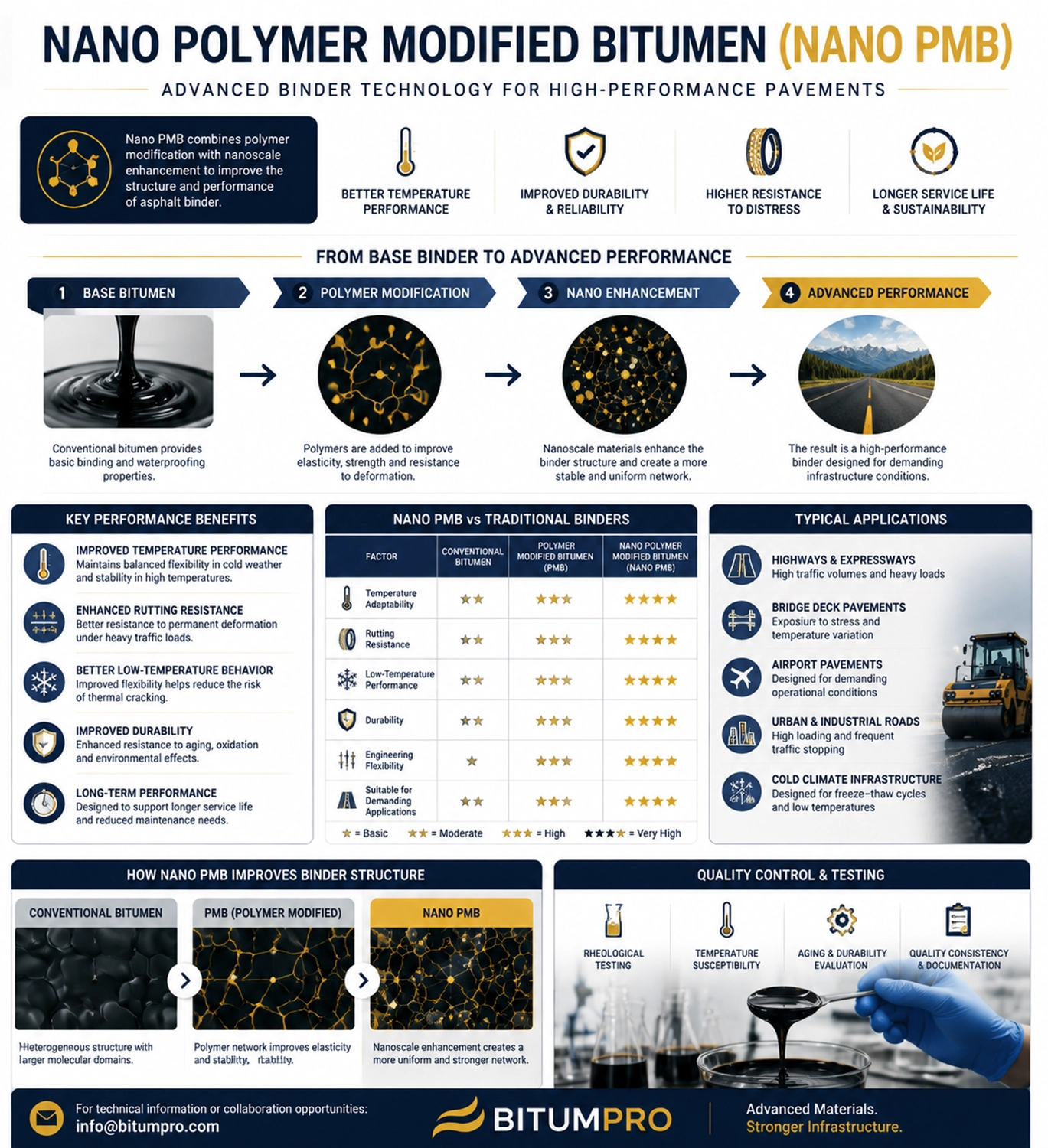
Applications of Nano Polymer Modified Bitumen
Advanced asphalt binders are typically considered for projects where pavement performance requirements exceed standard conditions.
Potential applications include:
Highway Infrastructure
Highways experience continuous traffic loading and require materials capable of maintaining performance over long service periods.
Heavy Traffic Roads
Urban and industrial roads with high axle loads may benefit from enhanced binder performance.
Bridge Deck Pavements
Bridge pavements often face additional stress due to structural movement, temperature variation, and traffic loading.
Airport Pavements
Airport surfaces require materials with reliable performance under demanding operational conditions.
Cold Climate Infrastructure
Regions with severe seasonal temperature changes require pavement materials designed for thermal challenges.
Why Cold Climate Regions Require Advanced Asphalt Binders
Cold climate pavement design requires careful consideration of binder behavior.
In regions such as Canada, asphalt materials must operate under conditions including:
- extremely low winter temperatures
- repeated freeze-thaw cycles
- seasonal expansion and contraction
- long-term environmental exposure
Selecting the appropriate binder technology is therefore an important engineering decision.
The Bitumpro business plan identifies British Columbia, Canada, as the initial target market for its Nano Polymer-Modified Asphalt Binder platform, focusing on infrastructure applications requiring advanced material performance. fileciteturn2file0
Quality Control and Testing of Advanced Asphalt Binders
Advanced binder technologies require systematic laboratory evaluation to confirm material consistency and performance characteristics.
Important evaluation areas may include:
- rheological behavior
- temperature performance
- binder stability
- modification consistency
- quality control documentation
Laboratory validation is an essential part of developing reliable asphalt materials for infrastructure applications.
Bitumpro's planned development approach includes laboratory validation and quality-focused production systems as part of its advanced asphalt binder platform. fileciteturn2file10
Bitumpro's Approach to Advanced Asphalt Binder Development
The development of advanced asphalt binder technologies requires more than material innovation alone. It involves a combination of research, laboratory evaluation, quality systems, and understanding of infrastructure requirements.
According to the Bitumpro business plan, the company is focused on developing a Nano Polymer-Modified Asphalt Binder platform designed for advanced infrastructure applications, with an initial market focus on British Columbia, Canada. fileciteturn2file0
The planned development approach includes:
- advanced binder formulation
- laboratory testing and validation
- quality-focused production systems
- collaboration with infrastructure stakeholders
The objective is to develop a performance-oriented asphalt binder solution for projects where conventional materials may not meet specific engineering requirements.
From Material Innovation to Infrastructure Performance
Advanced asphalt binders are not evaluated only by their chemical composition. Their value is determined by how effectively they perform within complete pavement systems.
A successful binder technology must consider:
- pavement design requirements
- climate conditions
- traffic loading
- construction practices
- quality control procedures
This means that material innovation must be connected with practical infrastructure needs.
For this reason, the development of Nano PMB requires cooperation between material scientists, pavement engineers, laboratories, and infrastructure stakeholders.
The Role of Laboratory Validation in Advanced Binder Development
Laboratory evaluation is a critical stage in understanding the behavior of modified asphalt binders.
Testing programs may evaluate characteristics such as:
Rheological Performance
Understanding how the binder responds to stress, loading, and temperature changes.
Temperature Behavior
Evaluating binder performance under different temperature conditions.
Modification Stability
Assessing whether the modified binder maintains consistent characteristics over time.
Quality Consistency
Ensuring that production processes deliver repeatable material properties.
A structured testing approach helps connect laboratory findings with real-world pavement applications.
Selecting the Right Asphalt Binder for Infrastructure Projects
Choosing an asphalt binder is a technical decision that depends on project requirements.
Important considerations include:
Climate Conditions
Different regions create different performance demands.
Cold climates require attention to low-temperature flexibility, while warmer environments may require improved resistance against deformation.
Traffic Loading
High-volume roads and industrial pavements may require binders with enhanced mechanical performance.
Pavement Design
The selected binder must work together with:
- aggregate properties
- asphalt mixture design
- construction specifications
- expected service conditions
A high-performance binder is not a universal replacement for all materials; it is an engineered solution selected according to application needs.
The Future of Advanced Asphalt Materials
The asphalt industry continues to move toward performance-based materials that are designed around specific challenges rather than general applications.
Future developments in asphalt binder technology are expected to focus on:
- improved durability
- optimized material efficiency
- better climate adaptability
- advanced laboratory characterization
- application-specific formulations
Nano-enhanced modification represents one pathway within this broader movement toward smarter infrastructure materials.
Why Nano PMB Matters for Modern Infrastructure
Infrastructure networks are long-term investments. The materials selected during construction influence maintenance requirements, operational reliability, and overall pavement performance.
Advanced binder technologies such as Nano PMB are being explored because they address a key challenge:
How can asphalt materials be engineered to perform more reliably under increasingly demanding conditions?
The answer depends on combining:
- material science
- engineering evaluation
- quality control
- practical field requirements
Rather than replacing traditional asphalt technology, advanced binders provide additional options for projects requiring higher performance levels.
Frequently Asked Questions About Nano Polymer Modified Bitumen
What is Nano Polymer Modified Bitumen?
Nano Polymer Modified Bitumen (Nano PMB) is an advanced asphalt binder technology that combines polymer modification with nanoscale enhancement approaches to improve binder performance characteristics.
Is Nano PMB the same as Polymer Modified Bitumen?
No. Polymer Modified Bitumen (PMB) uses polymers to improve asphalt binder properties, while Nano PMB refers to advanced modification approaches that incorporate nanoscale enhancement concepts in addition to polymer modification.
What are the benefits of Nano PMB?
Potential benefits of Nano PMB include improved temperature performance, enhanced binder stability, better resistance against deformation, and suitability for demanding pavement applications.
Actual performance depends on formulation, testing, materials, and application conditions.
Why are advanced asphalt binders important in cold climates?
Cold climates expose pavements to challenges such as low temperatures, freeze-thaw cycles, and seasonal stress variations. Advanced binders are designed to provide improved performance characteristics under these demanding conditions.
Where can Nano Polymer Modified Bitumen be used?
Potential applications include:
- highways
- heavy traffic roads
- bridge pavements
- airport pavements
- cold climate infrastructure projects
- specialized asphalt applications
How is Nano PMB performance evaluated?
Performance evaluation may include laboratory testing related to rheological behavior, temperature response, modification stability, and quality consistency.
Conclusion
Nano Polymer Modified Bitumen represents the continued evolution of asphalt binder technology from traditional materials toward engineered performance solutions.
As infrastructure requirements become more demanding, advanced binder technologies provide new opportunities to improve pavement reliability, especially in environments where temperature variation and traffic stress create significant challenges.
The future of asphalt materials will depend on combining scientific development, laboratory validation, and practical engineering requirements to create solutions that support more durable and resilient infrastructure systems.
Related Insights
Advanced asphalt binder technologies are part of a broader movement toward improving pavement performance through better material selection and engineering approaches.
Related topics:
- [What Is Polymer Modified Bitumen (PMB)?](/insights/what-is-polymer-modified-bitumen)
- [Understanding Asphalt Binder Performance and Selection](/insights/asphalt-binder-performance)
- [How Temperature Affects Bitumen Performance](/insights/temperature-effect-on-bitumen)
- [Bitumen Quality Control Testing Guide](/insights/bitumen-quality-control-tests)
Key Takeaways
- Nano Polymer Modified Bitumen (Nano PMB) is an advanced asphalt binder technology based on polymer modification and nanoscale enhancement approaches.
- The main objective of Nano PMB is improving binder performance for demanding infrastructure conditions.
- Cold climate regions require asphalt materials capable of handling low temperatures, freeze-thaw cycles, and seasonal stress variations.
- Binder selection should be based on project requirements, climate conditions, traffic loading, and performance expectations.
- Laboratory testing and quality control are essential for evaluating advanced asphalt binder technologies.
- Nano PMB represents one pathway toward more engineered and performance-focused asphalt materials.
Final Perspective
The future of asphalt infrastructure depends increasingly on materials that are designed for specific performance requirements rather than general applications.
As roads, highways, and transportation networks face greater environmental and operational challenges, advanced binder technologies provide new opportunities to improve pavement reliability and durability.
Nano Polymer Modified Bitumen represents an emerging approach within this evolution by combining polymer modification concepts with advanced material engineering.
The success of these technologies depends not only on innovation but also on:
- scientific validation
- laboratory testing
- engineering application
- consistent quality control
For infrastructure projects operating under demanding conditions, selecting the right asphalt binder remains a critical engineering decision.
Technical Information Request
For technical information about advanced asphalt binder technologies and material development approaches, contact the Bitumpro team.
References and Technical Notes
This article is based on publicly available asphalt engineering concepts and Bitumpro's business development documentation.
Bitumpro's business plan describes the company's focus on developing a Nano Polymer-Modified Asphalt Binder platform, including advanced material development, laboratory validation, and infrastructure applications in British Columbia, Canada. fileciteturn2file0
The document also identifies quality systems, laboratory testing, and collaboration with infrastructure stakeholders as important components of the planned development approach. fileciteturn2file10